Lipstick carries a history. It does not carry one meaning.
A cultural reading of color, respectability and self-expression—and what it changes about shopping advice.
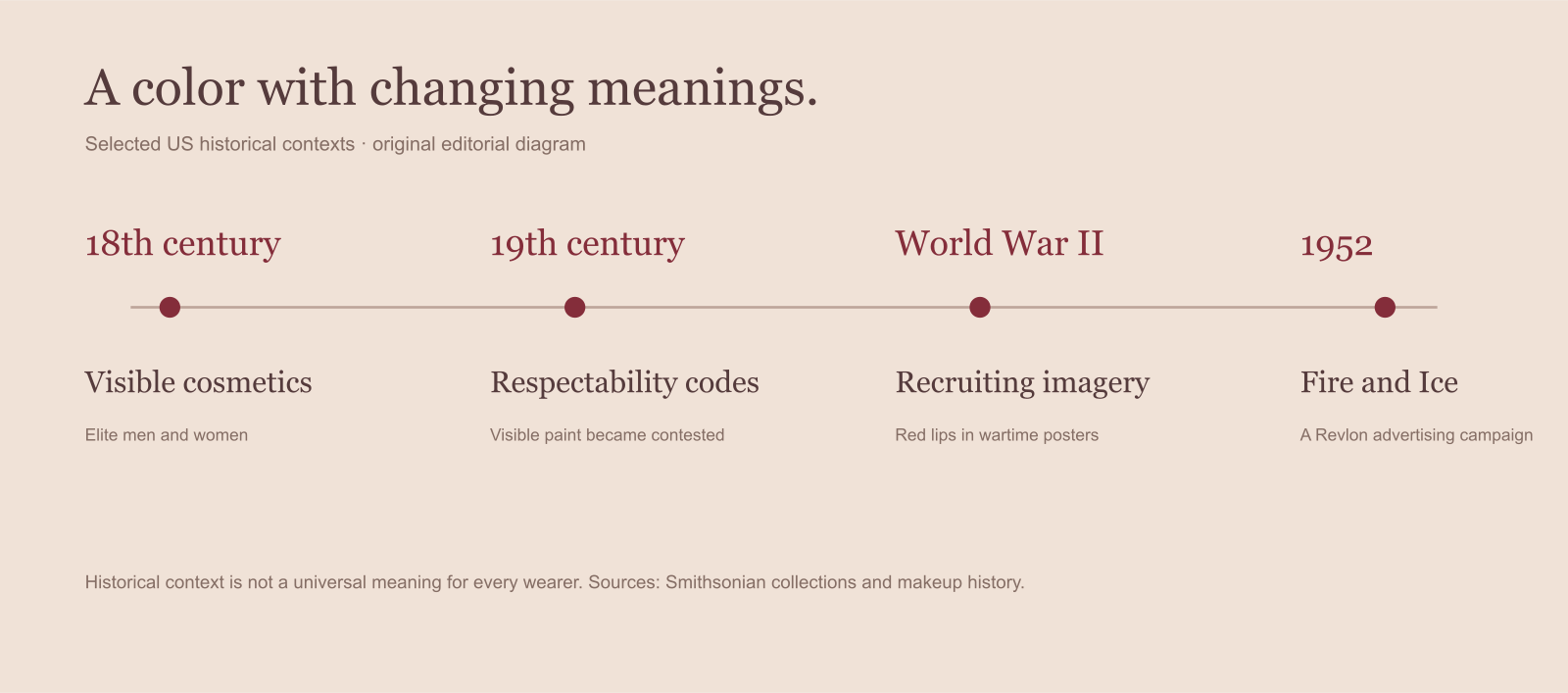
A familiar object with changing associations
A lipstick is a small object, but the meanings attached to it can be expansive: polish, play, confidence, conformity, glamour or simply a favorite color. Those associations are not permanent properties of red pigment. They depend on who is wearing it, who is looking and the social setting. Good beauty writing leaves room for that context instead of turning a product into a universal symbol.
The Smithsonian's account of American makeup history offers a useful example of change. It describes visible cosmetics worn by upper-class men and women in the eighteenth century, followed by a period in which conspicuous face paint became socially disapproved. The lesson is not that one period supplies the correct way to wear makeup. It is that familiar ideas about who makeup is for have a history.
Respectability was part of the sales pitch
Historical beauty advertising did more than describe products. It presented images of desirable identity and proposed routines for approaching them. When reading a vintage advertisement, ask what kind of person the image invites the viewer to become and who remains outside the picture. Packaging, shade names and suggested occasions can reveal that invitation even when the advertisement makes no explicit statement about social belonging.
This is an interpretive question, rather than proof that every customer accepted the intended message. People can use a product in ways that differ from the advertising. An ordinary purchase may involve practicality, pleasure, imitation, experimentation or several of these at once. A cultural account should not erase those individual reasons by assigning one political or psychological meaning to everyone who wears a certain color.
The red lip and public life
The Smithsonian also describes American wartime recruitment imagery that featured women in red lipstick. That context complicates the idea that a conspicuous lip is always an act of rebellion: a look can become part of an institutional image of the ideal citizen. The same visible feature can be read differently across settings. Specific historical examples are more useful than declaring red lipstick inherently liberating or inherently restrictive.
For a modern buyer, the practical lesson is to distinguish the story surrounding a color from the experience of wearing it. You may enjoy a red for its visual effect without adopting a grand narrative about confidence. You may also enjoy the narrative. Neither reason needs to be validated by a claim that the lipstick changes your character or gives everyone the same kind of power.
Who gets to be called natural?
Words such as natural and nude can sound descriptive while quietly assuming a reference person. A beige that blends into one person's lips may create a conspicuous contrast on another. In shopping terms, the useful question is relational: how does this color sit beside this wearer's lips and surrounding skin? A shade name cannot answer that on its own.
An inclusive guide therefore needs to show variation rather than appoint one shade as the default. That includes deeper natural lip color, differences between upper and lower lips and a range of preferred contrast. It also means avoiding age-based instructions that assign bright color to one group and muted color to another. Styling suggestions can offer choices without presenting personal features as problems to solve.
Write recommendations with room for agency
A deeper lipstick article can connect the cultural story to a concrete decision. If a brand sells ease, examine the actual steps of application and refreshing. If a shade is promoted as universal, examine the range of photographs and the coverage that allows natural lip color to contribute. If a campaign sells luxury, separate the pleasure of the object from any independently established difference in performance.
These questions create useful distance without treating enjoyment as foolish. People are allowed to appreciate a beautiful case, a nostalgic shade or a ritual that has no measurable efficiency benefit. Fragrant lips's role is to explain the available evidence and the tradeoffs, then leave the choice with the reader. This article draws a limited American historical thread; it is not a global chronology of lipstick or a claim that beauty practices share one origin.
Sources & further reading
This article is source-based cultural analysis. Historical examples illustrate specific contexts rather than a universal meaning for all wearers.