Read the lipstick advertisement before you read its promise.
Historical objects help separate a formula’s documented features from the identity a campaign invites us to buy.
Start with the documented differences.
| Formula | Described finish | A decision to consider |
|---|---|---|
| Revlon Super Lustrous Lipstick ↗ | Cream | A sheer balm is more relevant if you want your natural lip color to remain clearly visible. A matte product is the closer direction if a low-reflection surface is an essential part of the look. |
| L’Oréal Paris Colour Riche Satin Lipstick ↗ | Satin | Blurred Matte is more relevant if you want a softer-looking, low-shine edge. A liquid formula may be the closer research direction if you specifically want to work with a wand and a setting stage. |
Documentation-based comparison. No independent performance ranking.
A lipstick advertisement has more than one subject
A lipstick advertisement can describe a shade, demonstrate a finish, introduce a package, and invite the viewer to imagine a particular kind of life. Those jobs overlap, but they are not interchangeable. The confidence, sophistication, or freedom suggested by a campaign is different evidence from a disclosed application method or a clearly identified shade photograph.
Looking at older advertisements makes the distinction easier to see because their assumptions no longer feel quite so ordinary. A contemporary image can seem like a neutral representation of beauty; an archival one reveals how carefully a period’s ideal was constructed. The purpose of reading both is not to remove pleasure from lipstick. It is to keep the pleasure of a story from doing all the work in a practical product decision.
What the museum record establishes
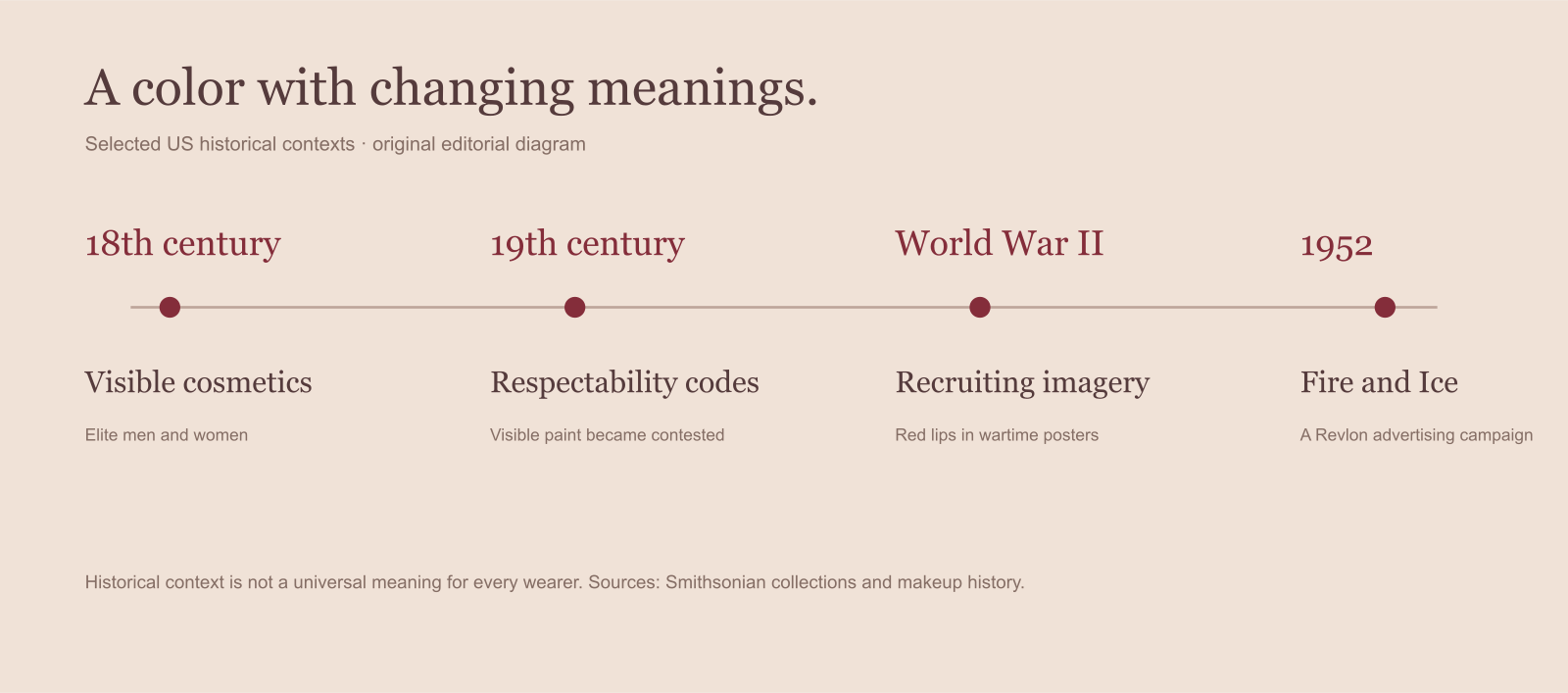
The National Museum of American History holds the Revlon, Incorporated Advertising Collection, covering print and television advertisements and promotional materials dated from 1936 to 1986. The museum describes the material as a resource for understanding depictions of beauty across decades. Its catalog also records a 1952 issue of Life containing an advertisement for Revlon’s Fire and Ice lipstick.
Those records establish concrete objects and a research context. They do not, on their own, prove how every reader understood a campaign, which consumers used the lipstick, or whether the formula performed well. The Fire and Ice title invites an interpretation built around contrast, but a historian would still need the advertisement, its context, and further evidence to make broader claims. Keeping the object record separate from interpretation is a useful habit for modern beauty coverage too.
Beauty meanings change with social circumstances
The Smithsonian’s makeup history traces changing American attitudes toward visible cosmetics, including earlier suspicion of conspicuous face color. It also describes wartime recruiting imagery showing women in lipstick as part of a feminine public identity. The same general cosmetic practice could therefore participate in quite different expectations across periods.
This is why a single story such as lipstick always symbolizes rebellion is too simple. Wearing a strong lip can express independence in one setting and satisfy a conventional expectation in another. It can also be done for pleasure without an intended social statement. A cultural guide should make room for those possibilities instead of treating a historic example as a permanent meaning carried inside every red tube.
Look for the person the campaign imagines
Begin a close reading with the imagined wearer. Who is shown, how are they dressed, what activity surrounds them, and what kind of attention is directed toward them? Then ask which viewers are invited to recognize themselves. An advertisement can promise a universal feeling while illustrating a narrow range of ages, complexions, bodies, or lifestyles.
These are questions to apply to a specific image, not a substitute for looking at it. A publication should not invent the details of an archival advertisement from its title, and an image should not be reproduced without checking its rights. A catalog link can still make the historical object discoverable while the article clearly states which observations came from the record and which require direct examination. Responsible cultural analysis is more precise than a decorative timeline.
Look for the role assigned to the product
Next, separate what the lipstick is from what the narrative says it enables. A product description might identify a matte finish, a solid bullet, or a supplied topcoat. An advertisement might connect that product to an evening, a personality, a relationship, or a version of success. Both can be interesting, but the second group does not establish the first group’s performance.
Names are part of this process. Words suggesting danger, innocence, power, luxury, or naturalness can make a color feel like an identity decision before it is worn. Ask whether the name helps identify a hue or mainly supplies a story. If the story is what attracts you, that is worth recognizing honestly. It should not be converted into unsupported claims that the lipstick will suit every professional setting or create confidence in every wearer.
Translate the image into a practical brief
After noticing the story, write down the visible effect you actually want to reproduce. Perhaps the attraction is a high-reflection red, a sharply defined border, a muted lip beside strong eye makeup, or a color that echoes clothing. Those details can guide a comparison of documented products without requiring the purchase of the campaign’s entire identity.
Then ask what the image leaves out. Is the exact shade identified? Is the color shown over another product? Does lighting contribute strongly to the appearance of shine? Does the photograph show application, wear, or only the first finished moment? A campaign does not have to answer every question, but a buying guide should identify the questions left open. That is where independent editorial work can add value beyond repeating the campaign language.
Keep enjoyment and evidence in the same decision
A reader can enjoy the history, name, package, or mood of a lipstick while still demanding clear information. The useful distinction is between a reason to be interested and evidence that a product meets a specific need. A memorable campaign may create the first; exact product identification, well-described comparisons, and documented observations support the second.
Our preferred approach is to preserve the story while narrowing the practical claim. Choose a desired effect, identify the relevant formula and shade, and compare it with alternatives that could serve the same role. Treat historical meanings as context rather than instructions about how a person should look. An advertisement becomes more interesting when it can be read critically, and a recommendation becomes more trustworthy when it explains what the story cannot establish.
Sources & further reading
This article is source-based cultural analysis. Historical examples illustrate specific contexts rather than a universal meaning for all wearers.